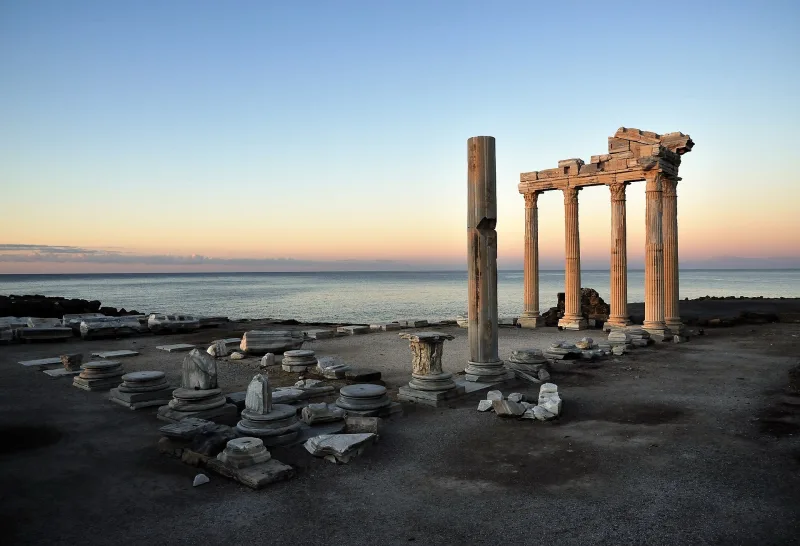
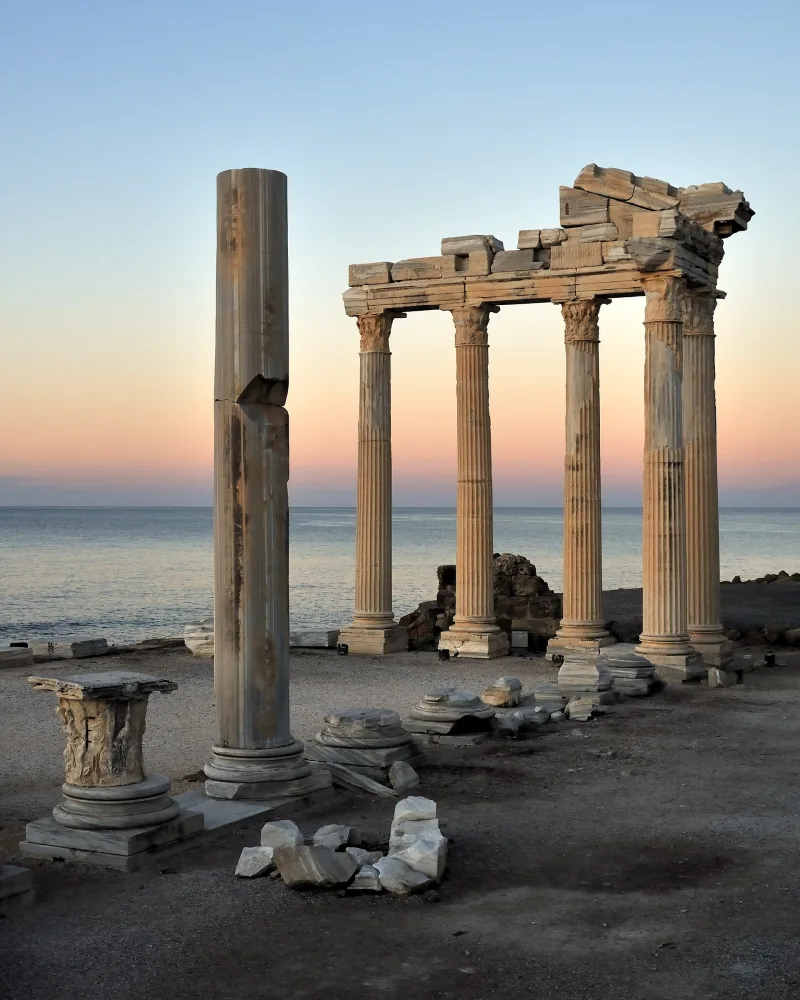
The Temple of Apollo in Side — Sunset over the Corinthian columns

The Temple of Apollo in Side: Five Columns on the Shore of the Mediterranean Sea

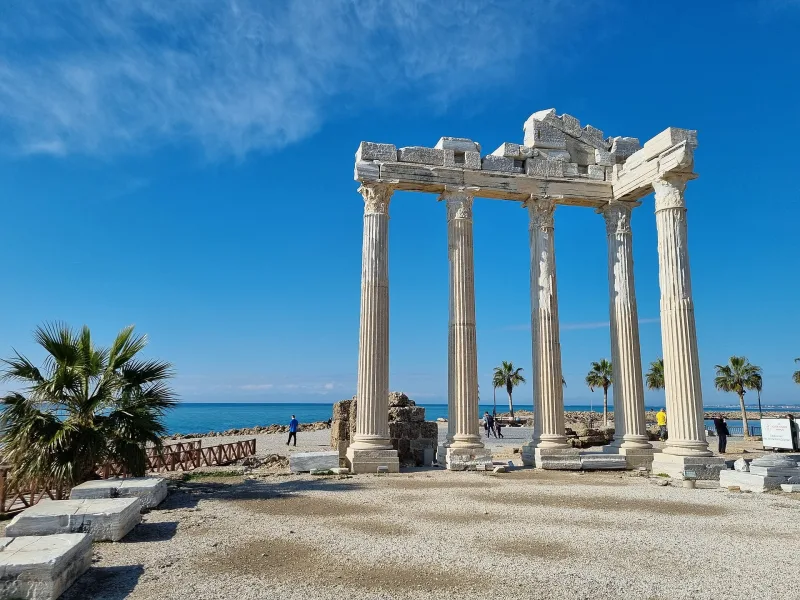
At the very tip of the ancient Side Peninsula, in the province of Antalya, amidst the ruins of the ancient port city stands one of Turkey’s most photogenic ancient monuments—the Temple of Apollo. Of the once-massive structure, only five Corinthian columns with an entablature have survived to this day, but it is precisely these five columns that have become the symbol of Side and one of the must-see sunset views along the Mediterranean coast. When the sun sets over the sea directly behind the temple, the silhouette of the columns is cast against the orange sky as if this scene were specially created for postcards.

History

Side was founded by Greek colonists from the Aeolian island of Cima in the 7th century BCE. The city quickly became a major port, an important hub for the slave trade, and the center of religious life in Pamphylia. Apollo was considered the city’s patron, and his temple stood at the very edge of the cape, at the entrance to the harbor—the location was chosen so that the temple would be the first thing approaching ships saw.

The existing temple was built around 150 CE, during the Pax Romana, under Emperor Antoninus Pius (138–161). This was the golden age of Roman cities in Asia Minor, when the state treasury and local nobility invested enormous sums in monumental construction. The Temple of Apollo stood next to the equally impressive Temple of Athena and, in fact, formed a single sacred complex with it.

In the 5th–6th centuries, following the triumph of Christianity, both temples were dismantled or converted into a basilica—a large early Christian church was erected in their place. By the Middle Ages, this church had also been abandoned, and Side was deserted following Arab raids. The ruins of the Temple of Apollo lay in a chaotic heap of fallen blocks until the 20th century.

Between 1984 and 1990, Turkish restorers carried out anastylosis—that is, they assembled five columns with an entablature from the original fragments found, restoring part of the temple’s eastern side. In 2017, additional restoration work was carried out: the concrete joints from the previous work had begun to crumble, exposing the rebar. Materials identical to those used in the 1980s were employed.

What to see

Five columns and an entablature

The main feature is the five restored Corinthian columns with finely crafted capitals and a shared entablature. The capitals are in the Late Corinthian order, featuring lush acanthus leaves and volutes. This is the most photographed spot in Side, especially at sunset.

The neighboring Temple of Athena

A few meters from the Temple of Apollo lie the foundations of the Temple of Athena—less impressive but interesting in terms of layout. Archaeological excavations at this site are ongoing, and from time to time, visitors can see specialists at work.

The Harbor and Cape The ruins themselves stand at the very tip of the peninsula, surrounded by water on three sides. This is the site of Side’s ancient harbor, where merchant and military ships once moored. Today, there is a short promenade here with a view of the turquoise sea and the beach to the right.

The Ancient City of Side

The Temple of Apollo is just one part of the vast Side Archaeological Park: nearby is a large amphitheater with 15,000 seats (one of the largest in Turkey), the agora, the baths (now a museum), a nymphaeum, and the colonnade of the main street. A walk through Old Side is a full day in the ancient city.

Interesting Facts

  • The temple was built around 150 CE during the reign of Emperor Antoninus Pius, at the height of Roman Pamphylia’s prosperity.
  • Of the entire massive structure, only five columns with a fragment of the entablature have been restored—this is the result of an anastylosis carried out between 1984 and 1990.
  • Apollo was the patron deity of the city of Side, and his temple stood at the very edge of the cape so that ships could see the sanctuary as they approached the harbor.
  • The Temple of Apollo stood next to the Temple of Athena—together they formed a sacred double complex, and during the Byzantine period, a basilica stood in their place.
  • In May 2022, a nightclub opened next to the temple, raising serious concerns among experts: the noise and lighting could interfere with archaeological work at the neighboring Temple of Athena.

How to get there

The temple is located in the town of Side (Manavgat district, Antalya province), at the very tip of the old peninsula. GPS coordinates: 36.7643° N, 31.3864° E. From Antalya Airport (AYT)—about 65 km along Highway D-400 (approximately one hour by car). Direct shuttles and dolmuşes run constantly.

From the town of Manavgat—about 5 km to the east—regular dolmuşes cost a couple of lira. Inside Side, car traffic is restricted: parking is available at the entrance to the old town, followed by a 10–15-minute walk to the temple. The walking route passes through the ancient gates and colonnade—that’s part of the fun.

Tips for travelers

The main tip is to come at sunset. Between 6 :00 and 8 :00 (depending on the season), the sun sets directly behind the columns, offering the most spectacular view on the entire coast. Dozens of photographers flock to the temple for this moment, but there’s plenty of room for everyone. An alternative is early morning: there are almost no tourists, and the light is soft.

You can tour the temple itself quickly—15–20 minutes is enough. But it’s easy to spend half a day in Side exploring the amphitheater, the agora, the museum, and the old street with its shops. Admission to the area around the temple is usually free; separate tickets are required for the museum and the amphitheater.

Wear comfortable shoes with closed toes (rocks and uneven paths). Bring water with you: in the summer, daytime temperatures easily exceed 35 °C. Combine your visit with a trip to the Manavgat Waterfall and the ancient city of Aspendos—in one long day, you’ll see the ancient classics of Pamphylia at their most spectacular.
Your comfort is important to us, click on the desired marker to create a route.
Meeting for minutes before
Yesterday. 17:48
Frequently asked questions — The Temple of Apollo in Side — Sunset over the Corinthian columns Answers to frequently asked questions about The Temple of Apollo in Side — Sunset over the Corinthian columns. Information about the service's operation, capabilities, and use.
The existing temple was built around 150 CE during the reign of the Roman Emperor Antoninus Pius (138–161). This was a period of prosperity for the cities of Asia Minor, when the state treasury and local nobility actively funded monumental construction projects. The temple stood next to the Temple of Athena, forming a single sacred complex with it at the entrance to the harbor.
In the 5th and 6th centuries, following the establishment of Christianity, both temples—those of Apollo and Athena—were dismantled, and an early Christian basilica was erected in their place. By the Middle Ages, the basilica had fallen into ruin following Arab raids. The ruins of the Temple of Apollo lay in a chaotic heap of fallen blocks until the 20th century. Between 1984 and 1990, Turkish restorers carried out an anastilosis—reassembling five Corinthian columns with an entablature from the original fragments.
Anastylosis is a restoration method in which a monument is reconstructed exclusively from its own recovered fragments, without the addition of new materials. Between 1984 and 1990, five columns of the Temple of Apollo were raised using this very method. In 2017, the restoration was repeated: the concrete joints from the previous work had begun to crumble and expose the rebar, so materials identical to those used in the 1980s were employed.
The location was chosen deliberately: Apollo was the patron god of Side, and his sanctuary stood at the very tip of the peninsula at the entrance to the harbor, so that ships could see the temple even as they approached the shore. This was a typical ancient practice—to place the most important sacred structures where they served as navigational landmarks and demonstrated the city’s power to those arriving by sea.
A walk around the temple itself is usually free—the cape is open to the public. However, separate tickets are required to enter the Side Museum (located in the ancient baths) and to visit the amphitheater. It’s best to check ticket prices right before your trip, as they change periodically.
No, the Temple of Apollo itself and the Side Archaeological Park are not included on the UNESCO World Heritage List. Nevertheless, Side is one of the most significant and best-preserved ancient cities in Pamphylia, and its historical value is recognized internationally.
Right next to it are the foundations of the Temple of Athena, where archaeological excavations are still underway. The entire historic Side Peninsula is essentially a vast archaeological park: it features a 15,000-seat amphitheater (one of the largest in Turkey), an agora, a nymphaeum, a colonnade along the main street, and a museum housed in ancient baths. You can walk around all of this in a single day.
In May 2022, a nightclub opened in the immediate vicinity of the Temple of Apollo. This raised serious concerns among experts: the noise and lighting installations posed a potential threat to the ongoing archaeological work at the site of the neighboring Temple of Athena. The situation attracted widespread public attention in Turkey.
Summers in Side are hot: daytime temperatures easily exceed 35 °C, and there is virtually no shade on the open headland. Visiting in the middle of the day in July–August requires serious preparation. It’s best to arrive early in the morning (before 10 :00) or in the late afternoon at sunset. We recommend bringing water, wearing a hat, and comfortable closed-toe shoes—the paths are uneven and made of stone.
It takes 15–20 minutes to tour the temple itself, but Side is an entire ancient city. The amphitheater, the agora, the museum, the nymphaeum, and a stroll along the colonnade of the main street can easily take half a day or more. If you add the nearby attractions—the Manavgat Waterfall and ancient Aspendos—you’ll have a full, eventful day exploring the best sites of Pamphylia.
User manual — The Temple of Apollo in Side — Sunset over the Corinthian columns The Temple of Apollo in Side — Sunset over the Corinthian columns User Guide with a description of the main functions, features, and principles of use.
The best times to visit are spring (April–May) and fall (September–October): comfortable temperatures, fewer tourists, and soft light. In summer, come early in the morning or at sunset—specifically in the evening, from around 6 :00 to 8 :00 (exact times vary by season)—when the sun sets directly behind the columns, creating the most spectacular silhouette of the coastline.
Side is about 65 km from Antalya Airport (AYT) via Highway D-400—roughly an hour by car or shuttle. Regular dolmuşes run from the town of Manavgat, located about 5 km to the east, at a minimal cost. Direct shuttles are also available from resort hotels in the area—please check with your host.
Vehicle traffic within historic Side is restricted. Parking lots are located at the entrance to the old town; from there, it’s a 10–15-minute walk to the Temple of Apollo. The route passes through the ancient gates and along the colonnade of the main street—this walk is part of the tour of the ancient city in itself, so take your time.
At the very tip of the cape, you’ll see five restored Corinthian columns with an entablature—the main attraction. Walk around them to admire the capitals adorned with acanthus leaves. Nearby are the foundations of the Temple of Athena: less visually striking, but interesting for understanding the layout of the dual sacred complex. If you’re lucky, you’ll see archaeologists at work.
After visiting the temple, head toward the 15,000-seat amphitheater—one of the largest in Turkey. Next, visit the agora, the nymphaeum, and the museum housed in the ancient baths (separate admission). The entire tour of Old Side takes anywhere from three hours to a full day, depending on your pace and interest in the details. It’s best to bring water and a snack with you.
If you have time, stay until evening: the sunset light transforms the five columns into one of the most recognizable silhouettes in the Mediterranean. The spot is popular with photographers, but there’s plenty of room. For the best shot, position yourself slightly to the right or left of center so that the sun sets on the horizon right between the columns.
If you have a full day, combine a visit to Side with a trip to Manavgat Waterfall (a 15-minute drive) and the ancient city of Aspendos, with its remarkably well-preserved Roman theater (about 30 km to the west). These three sites form a complete itinerary through ancient Pamphylia and can easily be covered in a single long day if you start early.